Videos
Additional Resources
- Garnet Families – An online hub for information, resources, and support for improving the lives of defence and PSP families
- Grappling with sleep disruptions (PSPNET Families)
- Improving sleep (PSPNET Families)
- Sleep Toolkit for PSP
- Sleep – Wounded Warriors
What we learned
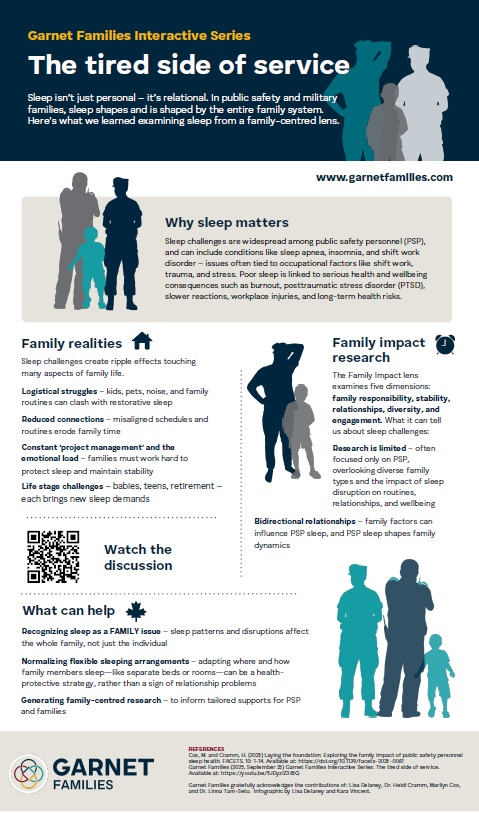
Sleep isn’t just personal — it’s relational. In Garnet Families, sleep shapes and is shaped by the entire family system. Here’s what we’ve learned using a family-centred lens.
Why sleep matters
- PSP Sleep Challenges are Widespread: Sleep apnea, insomnia, & shift work disorder are common, often tied to occupational factors like shift work, trauma, and stress.
• Serious Consequences: Poor sleep is linked to burnout, PTSD, slower reactions, workplace injuries, and long-term health risks.
• Fatigue management is essential: Managing fatigue is critical for PSP safety and wellbeing and, by extension, the communities they serve.
The Family Impact Lens
- Research Gap: Research often focuses on individual PSPs, overlooking family dynamics.
- Limited Family Data: Diverse family types (dual-serving, lone parent, multi-generational) aren’t really visible in the research to date.
- Families Feel it Too: Sleep disruption affects routines, relationships, and wellbeing.
- Bidirectional Relationship: Family factors can influence PSP sleep, and PSP sleep shapes family dynamics.
Family realities: Sleep as a systemic factor
- Sleep as “Another Character”: Always present, always shifting, shaping daily life.
- Life Stages Bring Challenges: Babies, teens, retirement — each brings new sleep demands.
- Logistics vs. Rest: Kids, pets, doorbells, noise, and routines often clash with restorative sleep, impacting sleep efficiency and continuity.
- “Constant Project Management”: Families work hard to maintain stability.
- Reduced Connection: Misaligned routines erode family time.
What families say: The shared struggle
- “It’s Not Uniquely Mine, But It’s Unique to Me”: Sleep disruption is a shared but personal struggle.
- Emotional Load: Families protect PSP sleep while keeping life running — impacting family responsibility and stability.
- Ripple Effects: Sleep loss touches meals, parenting, social life, and community engagement.
Where do we need to go
- Recognize Sleep as a Family Issue: Sleep patterns and disruptions affect the whole family, not just the individual.
- Normalize Flexible Sleep: Separate sleeping can be a valuable health-protective strategy, rather than a sign of relationship failure.
- Generate Family-Centred Research: Focus on the family impact principles: family responsibility, stability, relationships, diversity, and engagement1 — to inform tailored supports for PSPs and families.
About this discussion
Original event description
We invite you to join Marilyn Cox, Dr. Heidi Cramm, and Dr. Linna Tam-Seto as they broaden focus on the often-overlooked connection between sleep in public safety personnel (PSP) and their families. From shift work to trauma exposure, the demands of these high-stress jobs can lead to significant sleep disturbances, affecting both the serving member and their loved ones. Understanding these impacts lays the foundation for the development of tailored interventions and policies that support the sleep health and well-being of PSP and their families.
While this is an open event and all are welcome, please note, registration is required. Information gathered from this event will play a vital role in growing a community that will serve and support Garnet families across Canada. Following the event, attendees will be asked to complete a survey to inform the format, frequency, and themes of future Garnet Families activities. This event is presented in English with the option of French subtitles.
We would like to acknowledge the support of the Social Sciences and Humanities Research Council (SSHRC) Partnership Grant (What about the families? Strengthening a family’s research ecosystem for defence and public safety sectors) and the Medavie Foundation.
September 24, 2025.