Videos
What we learned
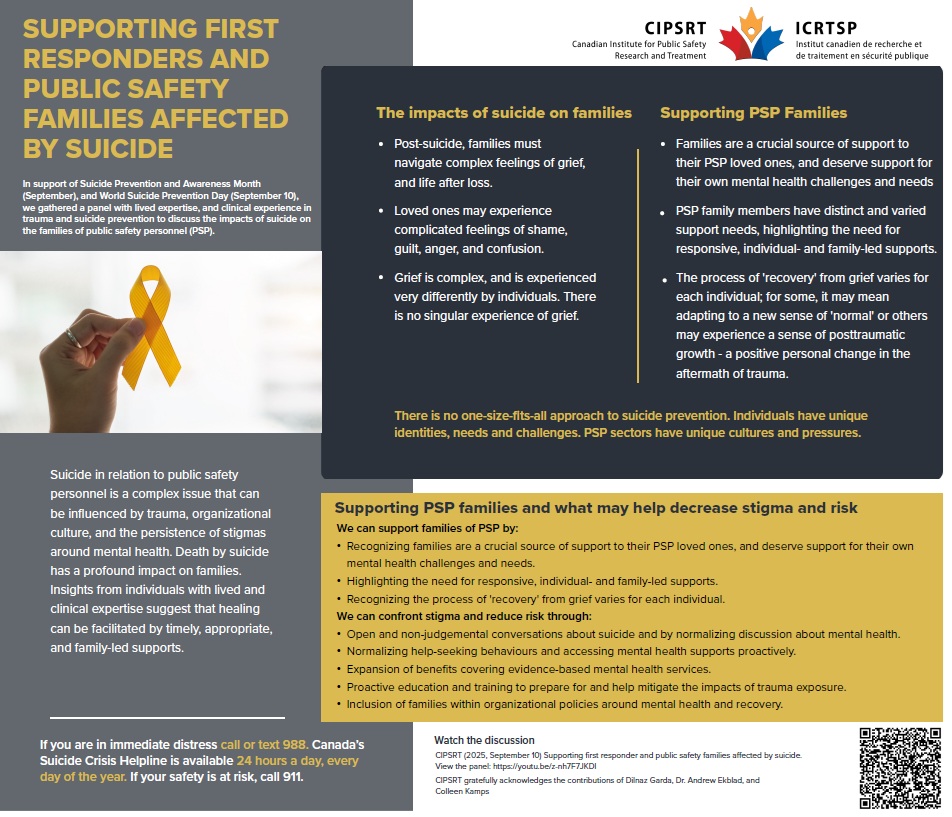
Panelists Dilnaz Garda (Toronto Beyond the Blue), Dr. Andrew Ekblad (Broadleaf Health), and Colleen Kamps (Tema Foundation) gathered in support of Suicide Prevention and Awareness Month (September) and World Suicide Prevention Day (September 10) to discuss suicide in relation to first responders and other public safety personnel (PSP) and the impacts of suicide on PSP families.
Trauma exposure and public safety work
Unique characteristics of PSP work, including frequent exposures to potentially psychologically traumatic events (PPTE), put PSP at an increased risk for developing mental health conditions like major depressive disorder, generalized anxiety disorder, and posttraumatic stress disorder, and at an increased risk for suicide. PSP experience other occupational stressors that can also impact mental health and wellbeing, such as shift work, irregular schedules, emotional exhaustion, and compassion fatigue. In addition, stigma surrounding mental health and suicide is common in PSP occupations.
Impacts of suicide on families
Panelists highlighted the ways that suicide impacts families, friends, organizations, and communities, and can increase the likelihood of another suicide occurring. The impact of suicide on families is long lasting. After a suicide occurs, families must navigate their grief and life after loss. Families may experience feelings of shame, guilt, anger, and confusion. Grief is complex and is experienced very differently by individuals. It may be prolonged, or it may appear later, and unexpectedly, emphasizing the need for extended support.
Recommendations that may help reduce suicide risk among PSP
Panelists noted that reducing the risk of suicide among PSP requires a community effort. Efforts to normalize therapy and seeking mental health support are needed to help reduce stigma. Having open and frank dialogue around suicide may also help to decrease stigma and encourage others to access support both within the workplace and at home. Expansion of benefits covering mental health services would allow PSP to access mental health support when and for how long they require it. Proactive mental health and wellness education training programs can be implemented prior to help prepare PSP for the challenges they will encounter. After a PPTE has occurred, organizations should provide immediate resources such as debriefing, peer support, and access to clinicians and professional mental health resources.
Recommendations for supporting families
Often a crucial source of support for their loved ones, families and caregivers of PSP may also experience stress and mental health challenges, such as anxiety, burnout, and compassion fatigue, yet they are largely excluded from organizational support for themselves or from participating in their loved one’s mental health plan. Panelists highlighted the need for organizations to include families in recovery and adopt policies that support the wellbeing of PSP and their families. Again, panelists emphasized that all families are unique, with unique needs and preferences, and that there is no-one-size-fits-all approach to providing appropriate support.
Key Takeaways
- Due to traumatic exposures encountered on the job, PSP are at an increased risk of posttraumatic stress injuries, and suicide
- Suicide has deep impacts on families, organizations, and communities, and families often struggle with complex feelings of shame, anger, guilt, and confusion
- Stigma within organizations, the wider society, and even self-stigmas may deter individuals from seeking access to mental health services; having frank and meaningful conversations about suicide can help reduce stigma
- Encouraging the proactive seeking of therapy and mental health services before one is in crisis can help normalize help-seeking behaviour and decrease stigmas around mental health
- Families play a vital role in supporting the mental health of PSP and should be considered within organizational policies around mental health and recovery; families should likewise be provided support for their own mental health challenges and needs
- Recovery from trauma, or from a loved one’s suicide is not necessarily about returning to one’s ‘old self,’ it can also involve acceptance, adaptation, change, and the potential for posttraumatic growth
About this discussion
Original event description:
This online discussion will examine suicidality among first responders and other public safety personnel (PSP), with an emphasis on the impacts of suicidality on PSP families. We will explore how past organizational and public health responses to suicidality among PSP have, at times, reinforced stigma around mental health challenges and suicide. We will highlight the efforts of families and mental health advocates to challenge these stigmas and to reframe these Line of Duty Deaths. And we will discuss the supports that family members need to assist loved ones, and themselves in proactively managing mental health as well as during and after times of crisis. Participants will:
- Gain insights into the common stigmas and assumptions surrounding PSP mental health and suicidality
- Examine and question harmful narratives related to PSP mental health
- Learn practical strategies and best practices for supporting PSP and their families in mental health and suicide awareness, intervention, and postvention
September 10, 2025.
Presenters
Dilnaz Garda
President, Toronto Beyond the Blue
Vice-President, Canada Beyond The Blue
Dilnaz Garda is dedicated to sharing her personal experience with mental illness in the hopes of encouraging others to share their stories and join in the movement of normalizing discussion around mental health. In 2016, tragedy struck her family when Toronto Police Constable Darius Garda, brother of Dilnaz, died by suicide while dealing with PTSD and other mental health issues. As the current President of Toronto BTB, and Vice-President of Canada BTB, Dilnaz works to make a sustainable cultural shift in the area of mental health and well-being for Toronto Police Service officers/members and their families.
Andrew Ekblad, Ph.D., C.Psych
Founder and Clinical Director, Broadleaf Health
Dr. Andrew Ekblad has over a decade of experience working with PSP and their families. He and his team at Broadleaf Health have helped numerous police services develop programming related to psychological wellness. He has provided clinical services to hundreds of PSP and family members and has provided a range of services including Annual Wellness Checks, early deployment skills training, evidence based treatment of psychological trauma, and suicide prevention. He has over 20 years of clinical and research experience in providing Dialectical Behaviour Therapy (DBT), an evidence based practice for treating suicidal behaviour and emotion dysregulation. Dr. Ekblad leads educational seminars and workshops for hospital, university, and community mental health practitioners throughout Canada, and has presented original research at international conferences and published academic articles on DBT, emergency department care of suicidal patients, and professional mentoring. Dr. Ekblad is an Adjunct Professor of Psychiatry at McMaster University.
Colleen Kamps MA, CYC
Director of Program Development and Advisory Services, Tema Foundation
Colleen is a licensed psychotherapist with a career spanning over four decades, specializing in mental health and wellness, suicidality, trauma, grief, and crisis intervention. She is an impassioned advocate for mental health through The Tema Foundation and is renowned for her expertise in trauma-informed training and therapy. Her compassionate approach and unwavering commitment to those she serves have earned her widespread recognition and respect in the helping field and first responder field. Colleen is deeply dedicated to destigmatizing mental health issues and promoting holistic wellbeing in her community through The Tema Foundation, her counselling practice, workshops, training, and advocacy efforts. Her passion, commitment, and dedication to helping others are what keep her striving forward to make life easier for those who need support.